
|
King County Critical Area Determinations (CAD)
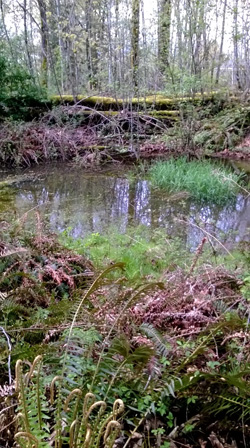
The first step towards development of a property in King
County that will require an on-site septic system is
going through the County’s Critical Areas Designation
(CAD) process. Any wetland or stream near a proposed
development activity must be flagged on-site and a
report submitted to the County. This is the work that
Aquatica Environmental Consulting performs.
How far away do you need to stay to avoid having to have
the wetland delineated? It is variable and is currently
determined on a case-by-case basis. The precise
distance depends on the buffer width and the proximity
of the development. Depending on the location of the
wetland and future development, the wetland may need to
be surveyed by a licensed land surveyor. Aquatica does
not provide this service.
Following receipt of Aquatica’s report, the County will
visit the site and verify the delineation and
wetland/stream classification. The County then writes a
CAD letter, summarizing critical area restrictions.
This process may take 6-8 weeks following submittal of
the completed CAD application. How long it takes depends
on the County’s work load. After you receive the CAD
letter from the County, you then can apply for an
on-site septic permit from the health department.
Approval from the health department may take 3 months or
more. A building permit usually can not be applied for
until after the septic permit has been applied for at
the health department.
Mitigation
The County only allows the disturbance of wetlands,
streams, or their buffers when it can not be reasonably
avoided. One common impact that occurs and is allowed
is when it is necessary to cross a wetland, stream or
buffer to access a property. Another common situation
is buffer averaging. This occurs when it is necessary
to reduce the buffer in one area, and there is room to
replace it elsewhere. This can allow for a smaller
buffer width in one area to allow development, while
increasing the width elsewhere. Whenever there are
wetland, stream, or buffer impacts, it is necessary to
“mitigate” the impacts. This requires the preparation
of a report and plan that describe exactly where the
impact is, how much area is involved, and what is
proposed to off-set the environmental impacts of the
project. The mitigation required typically involves
removing invasive vegetation and installing native trees
and shrubs.
With the large buffer widths on streams and wetlands,
there are now many properties that are almost entirely
constrained by wetland/stream and buffer. In those
situations, modest development on the property is
usually allowed, although it is necessary to get what is
called a critical areas alteration exception or
reasonable use exception. In this instance, it is
necessary to go through the SEPA process (see below), so
this process takes more time than a typical project
where such challenges do not occur. There are also
associated County fees that may be close to $10,000.
Properties that have to go through this process also
require mitigation, which adds additional costs.
Additionally, the County limits the amount of area that
can be disturbed, which may limit the size (foot print)
of the house, type of septic system and limit the
property owner to a small area of lawn/ornamental
landscaping. Aquatica can assist clients by preparing
mitigation plans and assisting with the
alteration/reasonable use processes.
Construction Review
Following the approval of a mitigation plan, the project
can be implemented. Plan implementation is required
before the County will give final approval on a
completed construction project, such as prior to
allowing a building to be occupied. Aquatica can assist
Clients by recommending landscape maintenance
contractors to implement the plan. It is also
recommended that a biologist from Aquatica inspect the
plants and their planting locations prior to
installation.
There are several benefits to having Aquatica review the
project prior to installation. Occasionally site
conditions change and it is necessary to modify the
plant species or their locations to ensure that the
plants will thrive once installed. Sometimes landscape
contractors inadvertently obtain an ornamental species
rather than native species, which then must be
replaced. Occasionally a nursery or contractor will try
to install “cheap” plants that are not of the required
size or of poor health. Sometimes nurseries sell small
plants in large pots that have not yet grown roots to
fill the pot. In this situation you are buying soil
when you want to buy plant roots! With a minimal amount
of time, Aquatica can help Clients ensure that
mitigation plantings get off to the best start possible
and that the Client is getting what they are paying
for. This is important due to the amount of money that
has likely been invested in the project so far, and
because there is a monitoring period (see below) in
which the success of the plantings are monitored. The
applicant is required to ensure that the majority of the
plants not only survive, but thrive for a period of
time.
Monitoring
After a mitigation plan is implemented (weeds removed,
plants installed, etc.), the County requires that the
area be monitored for three to five years, depending on
project complexity. This requires two site visits per
year and annual reports that summarize the condition of
the site. Monitoring typically includes identifying
plants by species, counting them to determine if
sufficient plants have survived, measuring their growth
and providing maintenance recommendations to ensure
project success. Aquatica can assist with monitoring
and submission of reports to the County.
Additional Government Regulations
The State/County recently have required that any project
that disturbs more than 1-acre (through clearing or
grading) or requires a hydraulic permit application for
in-stream work (HPA) must go through the State
Environmental Policy Act (SEPA). SEPA is also required
for larger development projects and
alteration/reasonable use exceptions. This process can
take a few months and requires a public notice period,
during which the public can comment on the project.
SEPA can be done concurrently with the building permit.
Clearing of property involving tree removal requires a
forest practices application (FPA) to obtain a permit
from the Department of Natural Resources. The FPA can
not be applied for until after a SEPA decision has been
made. Aquatica can assist with both SEPA and FPA
permitting.
Recommendations
If
you need a septic designer, surveyor, house designer,
well installer, geotechnical consultant or general
contractor for home building, Teresa, our wetland
specialist, can make a recommendation. She and her
husband have built a home in
unincorporated King County and have
personal experience with the “process”. And yes, it is
a process!
|